Manchester’s working week has changed dramatically, and the way thousands of people eat while at work is changing with it.
The traditional Monday-to-Friday commute has been replaced for many office workers by a more complicated pattern of home and workplace days. Tuesday, Wednesday and Thursday can see offices bustling with workers, while Mondays and particularly Fridays may tell a very different story.
And that shift is having an impact on everything from city-centre coffee shops to the businesses feeding workers behind office doors. Rather than maintaining permanent staff canteens or leaving employees to find their own lunch, some employers are arranging food specifically for the days when teams come together.
A different kind of working week
Manchester has undergone a remarkable transformation as a business destination over recent decades, with major employers spanning technology, media, finance, law, property and professional services. But hybrid working has fundamentally altered how many of those businesses use their offices.
Local companies providing catering in Manchester, including South Catering, can supply workplaces according to demand rather than requiring employers to operate permanent catering facilities of their own. Food can be ordered for a specific meeting, training day or event, or simply for occasions when the majority of a team is expected to be together.
“Office catering has become much more event-led, even when the ‘event’ is simply getting the whole team together on a Wednesday. Businesses want the days when people are physically together to feel useful, social and worth making the journey for.”
– Justin Gilchrist, South Catering
Why employers are buying lunch
Companies across Britain have spent several years trying to work out how, and how often, employees should return to the office. Workers value the time and money saved by avoiding a commute, while employers frequently point towards the benefits of face-to-face collaboration.
Offering food is hardly going to settle that argument. But employers have increasingly recognised that office days need to provide something that working from home cannot. Sharing a meal with colleagues is one of those things. Food provides an informal opportunity for people to talk without arranging another video call or putting a meeting into the diary.
The sandwich hasn’t disappeared
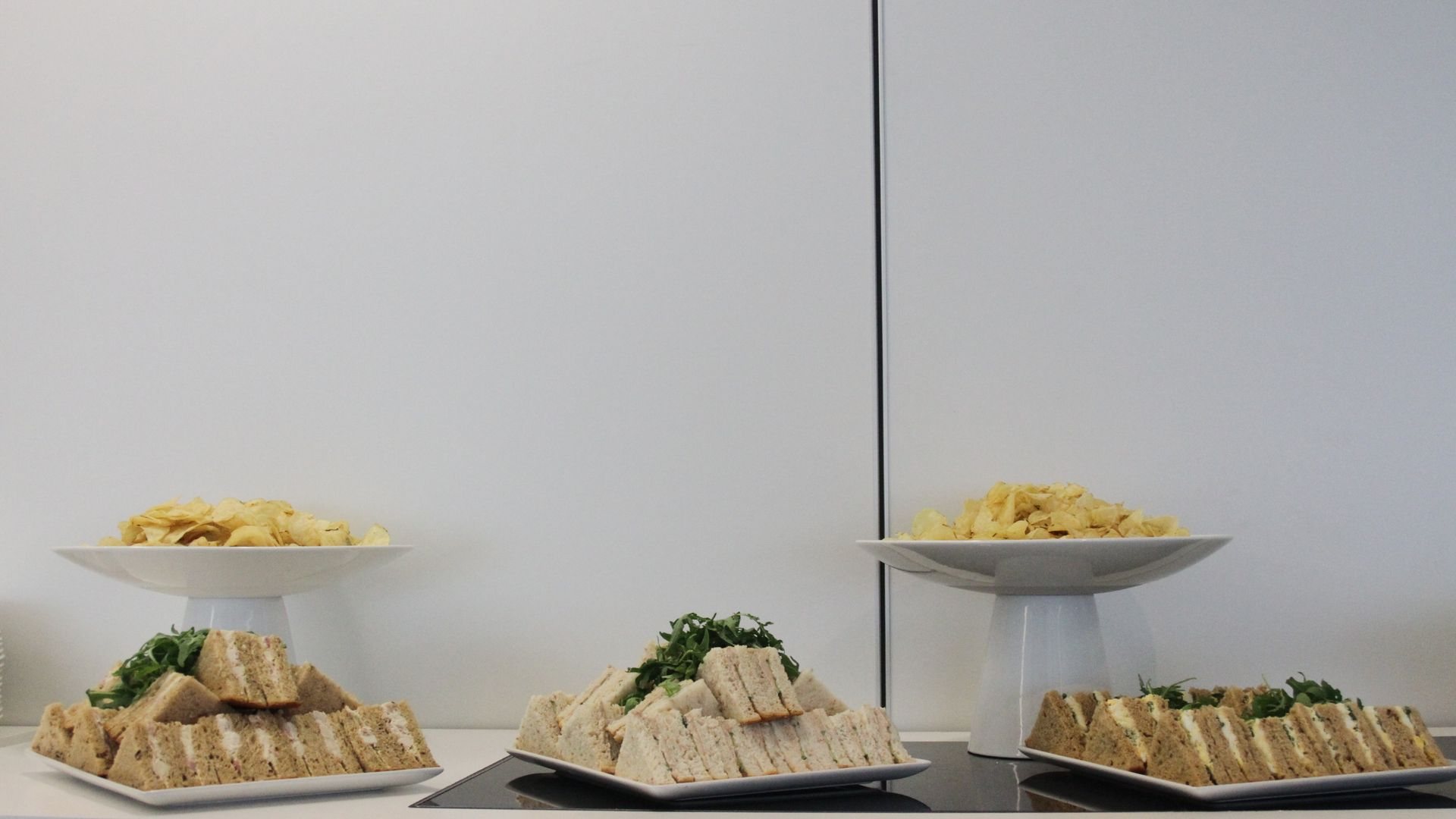
Despite changing tastes, the traditional sandwich remains a staple of workplace catering. Its longevity is partly down to practicality: sandwiches can be eaten without cutlery, divided easily between groups and supplied with numerous fillings to suit different tastes.
Businesses ordering from South Catering’s corporate catering menu can also choose from breakfasts, working lunches, salads, savouries and event options alongside sandwich platters, reflecting the wider range now expected from workplace food.
Waste is becoming a consideration
There is also growing pressure to avoid unnecessary food waste. Anyone who has attended a large corporate meeting will recognise the familiar sight of untouched sandwiches and cakes remaining after delegates have gone home. For businesses trying to reduce both costs and environmental impact, routinely over-ordering food makes little sense.
“One of the simplest ways to reduce waste is to get the headcount right and order for the people who are actually going to be there. Hybrid working has made numbers less predictable, but it has also made businesses much more conscious of what they order and when.”
– Justin Gilchrist, South Catering
The office is becoming an event
Perhaps the most interesting development is that an ordinary day in the office is gradually becoming something closer to an organised event. When everybody attended five days a week, there was little novelty in seeing colleagues. When teams are together only occasionally, those days carry greater significance.
Employers schedule meetings, presentations, training and social activities to coincide with them, and increasingly, lunch too. Manchester’s lunchtime economy is therefore unlikely to return completely to its pre-pandemic form. Thousands of workers may never again commute into the city five days every week.
But on the days when they do make the journey, businesses have more reason than ever to make their time together count. And sometimes, the simplest place to start is with lunch.
Contributed content: this article was written by a third-party contributor and does not necessarily reflect the views of National Headlines. Editorial and Advertising Policy