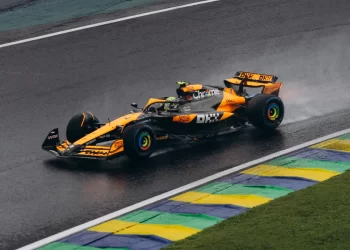
Pierre Gasly has been restored to third place in the Monaco Grand Prix after a successful Gasly Monaco penalty appeal by his Alpine team overturned two pit-lane speeding penalties, with the stewards accepting that Formula 1 used an inaccurate distance to calculate his speed.
Gasly had been demoted to seventh after the race, receiving two five-second penalties for exceeding the 60km/h pit-lane speed limit. Alpine requested a right of review hearing, presenting data that showed the measurement used in the official timing calculations was wrong.
Why the Gasly Monaco penalty appeal succeeded
The stewards found a 77-centimetre discrepancy between the official timekeeper’s measurement of the distance between two timing loops in the pit lane, and the distance measured by Alpine following the race, The Athletic reported. That gap arose because changes to the Monaco pit lane this year meant the shortest possible route between the loops was shorter than the distance used in the speed calculation.
According to ESPN, evidence presented to the stewards showed that ‘the distance used in calculating the F1 Official Timing [and hence the pit lane speed] was inaccurate and overestimated the speed of Car 10.’ Car 10 is Gasly’s race number.
The pit-lane speed limit is measured by recording the time taken to travel a specific distance along the pit lane via a series of timing loops. Because the true distance was 77cm shorter than the figure used in the calculations, cars travelling within the limit were being recorded as marginally over it.
Five of the six offences that were issued were for cars calculated to be travelling at 0.1km/h over the limit. One of Gasly’s two offences was recorded at 0.4km/h over. The stewards accepted Alpine’s argument, backed by data, that Gasly had never exceeded the 60km/h limit, and his third-place finish was reinstated.
Championship impact and remaining consequences
The reinstatement carries real championship weight. According to BBC Sport, the extra nine points from Monaco move Gasly from 10th to eighth in the drivers’ championship standings.
Oscar Piastri, who had moved up to third following the original post-race penalties, drops back to fifth as a result of the decision. Piastri had lost three places in serving his own pit-lane speeding penalty during the race.
The outcome is particularly pointed for George Russell. His Mercedes team did not request a review, even though they believed he had not exceeded the limit. Russell was given a drive-through penalty for pit-lane speeding during the race, which dropped him from third at the time to 13th at the finish. Unlike Gasly’s, that penalty cannot now be revisited through the same right of review process that Alpine pursued.
Russell was one of five drivers penalised for pit-lane speeding across the race, an unusually high number that prompted the stewards themselves to question the penalties when the third one was issued. The verdict noted that race control had contacted the official timekeepers at that point and been told there was no issue and that the data was accurate.
Lewis Hamilton and Franco Colapinto were the other two drivers penalised. Hamilton’s penalty did not affect his second-place finish, as Ferrari managed to serve it during a safety-car period without losing track position. Colapinto is Gasly’s team-mate.
The stewards’ findings draw a clear line: Gasly’s reinstatement was possible because Alpine acted swiftly to gather and present measurement data, while the teams that did not appeal have no equivalent route back.
McLaren to contest the ruling
McLaren have expressed an intention to appeal against the stewards’ decision to reinstate Gasly. Piastri’s drop from third to fifth as a direct result of the ruling gives McLaren a concrete sporting interest in contesting the outcome. No further timetable for that process has been confirmed.